

Domain - My heart skipped a beat: Architect finds his dream home.
Imagine buying your dream home. Not just a particularly appealing style of house, but the exact address that had long captivated you. Few can lay claim to achieving that.

Image by Julian Kingman
Surf Coast-based architect Josh Crosbie fulfilled this fantasy last February when he purchased the Lorne modernist masterpiece, Trade Winds, which he had always deeply admired.
Trade Winds was tightly held by one family, and Crosbie has become the custodian, pleasing the vendor with his vision of keeping the home respectfully intact.
Crosbie has embarked on a thoughtful restoration at Trade Winds, and the cliff-side property – visible from the Great Ocean Road – can be rented for holiday stays from July through to September.
The 1965 house, built by Ted Yates, had been on the market for only a few hours when Crosbie saw the listing, called the agent and declared he would be there to inspect it in 10 minutes. He was compelled and determined to move quickly to make it his own.
I remember saying out loud, 'that is my house', Crosbie says, recalling how he fell into reverent silence when strolling through that first time. “I remember walking around, looking at all the detailing … I was absolutely being swept away.
'My heart skipped a beat. The inside was as original and in as good condition as the outside.'
'It is really hard for new houses to have a story to them, to have that dialogue or language, or soul. For a new house to become a home, it's easier said than done.'
Crosbie says he loves the mid-century design's 'clean, deliberate, purposeful language'.
'Every time I had driven underneath it, I would ogle it and say 'wow, that is so beautiful'. It was always my favourite house on the coastline.
'Looking up on the hill, the house stands out because it is a long, skinny line that assimilates with the landscape really elegantly, really softly. It disappears into the landscape, and that is why I love it.'

Planning permits came through while awaiting settlement. Soon after, Crosbie assembled some mates to help him restore the home and a respectful, harmonious extension to lend more storage and add a sub-floor bedroom. Garden landscaping was the final touch.
The materials and age required sensitivity and specific materials and skills to maintain its integrity.
'We realised that some aspects of the house are what I would call sacred,' he says.
Among the most delicate projects were the facade, the kitchen, the window frames and joinery throughout, and small improvements, including plaster touch-ups and painting.
The window frames, which surround dramatic ocean vistas, alone required six weeks of attention to be stripped, sanded and re-oiled.
For Crosbie, acquiring the keys to Trade Winds as the COVID pandemic unfolded and his personal life dramatically changed was a sort of salvation. Since then, Josh Crosbie Architects has expanded, opening a second office at Newtown, in addition to the Lorne studio.
'This house was my angel; it was meant to be. It kept me from fleeing to some cold, beautiful part of Alaska,' Crosbie jokes.
Crosbie acquired the original furniture in the sale, which includes Gerald Easdon, Brdr Andersen and Danish Deluxe.

The south-facing position of Trade Winds is graced by a private path to the North Lorne beach. Crosbie describes the views from the home as breathtaking. The house, hanging above the breaking waves that kiss the Great Ocean Road, seems open to the scenery.
'When you walk through the front door, it can really look like it is not real. Your jaw just drops. The windows run from the floor to the ceiling, and wall to wall, literally unbroken, so it feels like you could throw a rock out and it would fall in the ocean.'

Navigating local complexities to create beautiful architectural designs
My Coastal Home podcast (E.13) featuring Geelong architect Josh Crosbie

Great design process should be a fluid process
Eight years ago, Josh Crosbie made his way to an opportunity shop and donated his suits. It was a pivotal moment in his career as an architect – he was moving away from large-scale commercial work in Melbourne to bespoke houses and smaller-scale commercial projects. This shift in career direction led Josh to open Josh Crosbie Architects on the Great Ocean Road at Lorne, and recently at 352 Pakington Street, Newtown, Geelong where suits are no longer needed.
“I knew from when I was in primary school that I wanted to be an architect,” Josh said.
“I’ve always had a deep desire to understand how things are made and I always loved drawing as well, so from a very young age I was looking for a way to combine those two passions.”
Josh has combined these passions for the past 13 years after completing degrees in Architecture and Construction Management at Deakin University’s Waterfront campus. He refined his craft working as a commercial project manager in Melbourne for three different consultancies on large scale $500 million projects for his first five years out of university, and credits mentors including architect Rob Hutton, from the Bellarine Peninsula, for helping him refine his skills.
“He used freehand drafting and is very careful and meticulous in his work,” Josh said of Rob. “This was a great inspiration for me as it seems our freehand art is become a dying breed, sadly. “I’m proud to still use freehand art as part of my practice today.”
The desire to help people realise vision for a dwelling and create meaningful and lasting buildings is one of Josh’s favourite aspects of his profession, as well as fostering informed client relationships.
“I hope to continue creating beautiful spaces for people and to make their development process an enjoyable one – far too often sadly the building and design process can lead to disputes.
“This process is usually a very daunting prospect for property owners so we start by making the journey ahead easy to understand and digest.”
Josh begins by engaging clients with a site analysis and free hand sketches in a more collaborative approach to initial concept work – the “fun” part for clients to help them understand the design process or, as Josh says, “the method to the madness”.
“Our designs are first and foremost for our clients – so delivering to their taste is paramount,” Josh said.
“Having said that we do love natural textures and elements, so recycled hardwood and rammed earth walls are common for us. If the project is more modern or sharp, then concrete, ply, steel and glass are well used.”
“Our designs are the best possible balance we can achieve between the brief, the site and thier budget. That means delivering clients’ needs which are site responsive to their land and affordable to them.”
Josh’s words of wisdom for people beginning their design journey is simple: “a great design process should be a fluid process so find the best architect who you’ll feel comfortable with to nurture you along this journey”.
While one piece of advice he hopes to teach others in the industry is to provide clients with realistic and informed advice on budgets and expectations from the very beginning. “This is where a lot of our profession struggle, unfortunately.”
Personally inspired by rugged elements in nature, particularly in coastal and alpine environments, Josh also has a love for Modernism from the 1930s to the ‘60s: deco, international style and mid-century. Frank Lloyd Wright and Mies Van Der Rohe are also in his inspirational mix. Josh focuses on-site responsive and environmentally conscious designs, allowing natural textures and simple built forms to do the talking. “We don’t really work on ‘out there’ massive projects down the coast very much which often seem to scream out for attention – we enjoy working on more grounded and humble projects for discerning owners.
“Responsible and appropriate design to a local area is very important to us.”

Sustainable design is a focus at Josh Crosbie Architects
Where the pursuit of an environmentally conscious building also factors in economic and social sustainability practices.
“Simple design pursuits and best practices make an enormous difference to your environmental impact (carbon footprint) and will improve your quality of living at the same time: passive solar gain, natural ventilation, thermal mass, insulation in the right places and so on.”
Hardwood, recycled where possible, is featured regularly in Josh’s designs because of its hardy nature, perfect for coastal environments, and its response to nature by greying off and darkening when wet.
“The species we use regularly are also compliant to BAL29 ratings, which means they give improved resistance to ember attack during a bushfire.
“The Surf Coast is a really unique landscape where cool temperate rainforest meets this stunning coastline – so this makes for amazing design opportunities which capture the views yet ideally assimilate well into their surroundings.”
“We love our niche down here and we navigate the local complexities of bushfire risk, steep hillside sites, lots of native vegetation, tricky access, land instability and a myriad of planning controls amongst other challenges.”
Article by Surf Times by Lydia Kennedy
See our latest architectural designs
Grand Designs Australia
At the tender age of just five years old, adventurous Josh Crosbie knew he wanted to be an architect when he grew up. “I’ve always loved drawing and designing things,” he explains. “This profession allowed me to combine my passions whilst helping people create their projects and realise their visions.”
At the tender age of just five years old, adventurous Josh Crosbie knew he wanted to be an architect when he grew up. “I’ve always loved drawing and designing things,” he explains. “This profession allowed me to combine my passions whilst helping people create their projects and realise their visions.”

Something else Josh developed young was a love for extreme sports. “I started skiing with my family when I was two and I started rock climbing with my dad when I was about 10,” he recalls, explaining that mountaineering and snowboarding have since become his favourite pastimes. Every year he also sneaks away to Europe to enjoy alpine BASE jumping with friends. “I understand that some people label these pursuits as extreme sports,” he says, “but they’re just my passions — I crave nature and the beautiful wilderness of these mountain environments.”
During these jaunts, Josh finds limitless architectural inspiration. “I love exploring the houses in those parts of the world as they’re a lovely representation of their cultures,” he says. “I most admire the functional approach of these houses, where simple and effective details and forms are more important than superficial aesthetics.” As an example, he cites the beautiful traditional stone homes with massive exposed trusses and lofts he observed in the Dolomites region of northern Italy.
Closer to home, the vastness of the Aussie rural bushland, the beauty of the alpine high country and the ruggedness of the south coast’s beaches and coastline are his guiding lights. “These wild and natural environments inspire me to create adaptable and responsive architecture that’s robust and well considered,” he explains.
While studying at Geelong’s Deakin University — Josh completed a double honours degree of Architecture and Construction Management — he worked for two local architects, gaining plenty of residential experience, including freehand drawings: “I’m grateful for that opportunity to learn our craft in the traditional way,” he enthuses.
Having spent the first five years of his career on big commercial projects in consultancy firms, Josh established his own practice 10 years ago. “That shift allowed me to be more relationship-focused with clients directly rather than delivering large-scale projects for organisations or corporations,” he says. “Seven years ago my family and I moved to Lorne on the Great Ocean Road where I opened my gorgeous boutique design studio.”

AN ARCHITECT OF MANY STYLES
For Josh and his team — he recently expanded to a second studio in Geelong’s Newtown — truly understanding clients’ tastes and preferences is key. “We focus on completing designs that assimilate well into their surroundings,” he says, “so our design style’s certainly varied. We’ve completed many modern houses along the Surf Coast that follow the 1950s-inspired Surf Coast style (flat roofs, simple forms), but we love working with different genres — contemporary, French provincial, country, and restoring heritage-listed period houses.”
Many of their favourite projects, he adds, are renovations in which they salvaged an older house rather than taking the easy approach of demolition. “Despite the inherent risks, there’s a noble integrity about this process and we enjoy these challenges.”
Regarding Australian design, Josh believes it’s all about connection to landscape through site-responsive design. “Our favourite design elements include natural textures like rammed earth, concrete, native hardwood, steel and glass, and we love adopting clean, strong, horizontal lines that sit beautifully within our vast rural landscape, or perched alongside the ocean’s horizon.”
As a philosophy on both design and life, Josh strongly believes in keeping it simple: “There’s no need to overcomplicate things or unnecessarily adorn our journey.”
The Crosbie family home — Dorman, in Lorne — is a perfect example of this architect’s penchant for preservation. “It’s seen an extensive restoration to the original gorgeous 1960s beach house over the last seven years since we bought it,” Josh explains. “We’ve been careful to maintain the existing character and charm… lovely qualities like the exposed beams, internal timber lining and the stone fireplace. We started with the landscaping, actually, shaping three terraces into the slope and importing rough and natural elements like huge granite boulders, recycled jarrah sleepers, sandstone blocks from the 18th century and native plantings. Most recently we’ve come back to the landscaping, creating three amazing treehouses.”
It’s probably no coincidence that Josh completed his thesis more than 10 years ago on treehouses. “I’ve always loved the notion of spending time within the forest treetops,” he says. “Building our treehouses [pictured right] took more than a year as we were really careful to create them in a way that wouldn’t hurt the host trees: not a single bolt or nail fixing into the trees was used.” Instead, they created tension collars that allow for easy adjustment and for the trees to continue to grow and move in the wind. Indeed, Josh recalls studying such principles of biomimicry at university. “We’re proud that only salvaged, second-hand materials have been used, too,” he adds. “Now we have three interconnected treehouses that we enjoy every day, whether for kids’ playtime, yoga, reading a book or relaxing on the ‘top deck’ with a bottle of red looking over the ocean.”

FACING THE RIGHT WAY
Perhaps not surprisingly for someone over whom nature has such a powerful hold, sustainability is frequently at the forefront of Josh’s design. “The most important step towards environmentally conscious buildings for my firm is also one of the simplest pursuits: the orientation,” he reveals. “We can significantly reduce the energy consumption to heat and cool our buildings by facing our living areas towards the north so that the winter sun can passively warm the spaces and they become abundant with natural light. Summer sun, which sits much higher in the sky, can be adequately blocked with eaves or external shading.”
It’s often easier said than done to reach this ideal, he concedes. “Many sites have challenging aspects, especially along the Surf Coast, with predominantly south-east views over the ocean.” Here he recommends employing some design tricks, including avoiding exposure of glazed elements to the west, and internal cross-flow ventilation.
The energy needed to run our homes should also be reduced, using active means such as selecting quality fittings and finishes, Josh says. “Up to 90 per cent of the heat loss of an insulated building envelope will be through the windows, so their size and location should be carefully considered. Thankfully the cost for high-spec windows has come down a lot in recent years, thanks to increased residential uptake, and now thermally broken frames, double glazing with inert gas, solar tints and low-emissivity coatings are common.”
The carbon footprint and embodied energy of our houses can and should be reduced through the selection of secondhand or recycled materials where possible, he adds, citing Earthwool recycled glass insulation batts as one example. “We can also reduce the consumption of materials/goods and the creation of waste by carefully designing the size of our spaces to match the availability or modules of those materials,” he adds. “For example, selecting ceiling heights in 30cm increments avoids waste with each timber wall stud.”
Despite the significant investment required for stand-alone solar and battery setups, Josh also encourages his clients to purchase 100 per cent accredited green renewable energy “as an immediate way to avoid the greenhouse gases of traditional brown coal-powered electricity”.
Looking to the future, Josh is hopeful of change within the industry he loves. “I personally don’t think the reputation of the design industry is very good at the moment,” he says. “At the risk of alienating us from the architectural fraternity, I think we’re still suffering in the shadows of some egotistical architects from past decades who ran their projects with a ‘my way or the highway’ attitude towards the builders, and sometimes their clients too! It’s my humble opinion that today’s architects should focus on a few simple qualities: understanding our clients’ needs and preferences; creating buildings with practical and buildable detailing; respecting the budget and gaining meaningful cost-estimating experience; and teamwork, teamwork, teamwork.”
Nevertheless, Josh is eternally grateful to be able to make a living from doing the things he loves. “I feel so fortunate to be able to help people in what is often a very daunting and confusing process.”

Buyers lining up to show appreciation for Lorne architect Josh Crosbies family home
ARCHITECT Josh Crosbie is selling his revamped 1960s Lorne beach house that’s been artfully transformed into a laid-back coastal escape overlooking Louttit Bay.
It was love at first sight when the Surf Coast resident and his young family first bought the property more than 10 years ago.

ARCHITECT Josh Crosbie is selling his revamped 1960s Lorne beach house that’s been artfully transformed into a laid-back coastal escape overlooking Louttit Bay.
It was love at first sight when the Surf Coast resident and his young family first bought the property more than 10 years ago before embarking on a sympathetic renovation that blends into the natural environment.
It looks as if history could repeat itself with buyers already lining up for the re-imaged four-bedroom house, just 100 metres from the water’s edge.

The house is clad in a native, fire-resistant hardwood.

Architect Josh Crosbie redesigned the 1960s house for his family.
Clad in silver top ash, the elevated two-storey home at 31 Dorman St sits among coastal stringybarks on a fun-filled 874sq m block that’s also home to three Robinson Crusoe-inspired tree houses and a rock climbing wall.
An expansive Turkish travertine-tiled deck captures dreamy ocean views, while gardens landscaped with 30 tonnes of granite boulders, recycled jarrah sleepers and late 1700s convict hand-pecked sandstone blocks add a finishing touch.

Handmade Moroccan tiles add a splash of colour in the kitchen.

The 50sq m deck offers ocean views.
Great Ocean Road Real Estate, Lorne agent Craig Willmott said buyers were swooning over the original feel and quality of the renovation.
“I reckon (Josh) has hit the nail on the head,” Mr Willmott said.
“You see a lot of stuff that is really on the contemporary side, with white everywhere, white marble, white paint and it’s kind of nice to see something that is way more in harmony with the original beach house.
“I have to say what people like about it is just that 1970s style, that retro feel.”

The relaxed family room.

The backyard is paradise for kids.
He said the open-plan kitchen, dining and living area was a highlight as it opened to the ocean on one side and the landscaped gardens on the other.
Handmade Moroccan tiles, Smeg appliances and an original PH5 light were carefully chosen for the space, while outside bronze nails were imported from the US.
Each of the four bedrooms on the main level also have deck access, while downstairs is a self-contained studio, double garage and storage room.

The self-contained studio.

One of two bathrooms at the property.
Mr Willmott said another bonus was the approved plans and permits for a third level that would house a main bedroom suite and a parents’ retreat with ocean views.
“It’s really hard to get approval to go up a level, especially in Lorne,” he said.
“If someone turned around and did that, the amount of accommodation would be amazing.”
The property is listed for $1.65 million.
The Design Files - A Home That Blends Seamlessly Into Its Bushy Surrounds
When embarking upon a new build on a vacant block, the surrounding natural environment should always be a priority. For Lorne-based firm Josh Crosbie Architects, fostering a connection to existing wildlife is a core value.
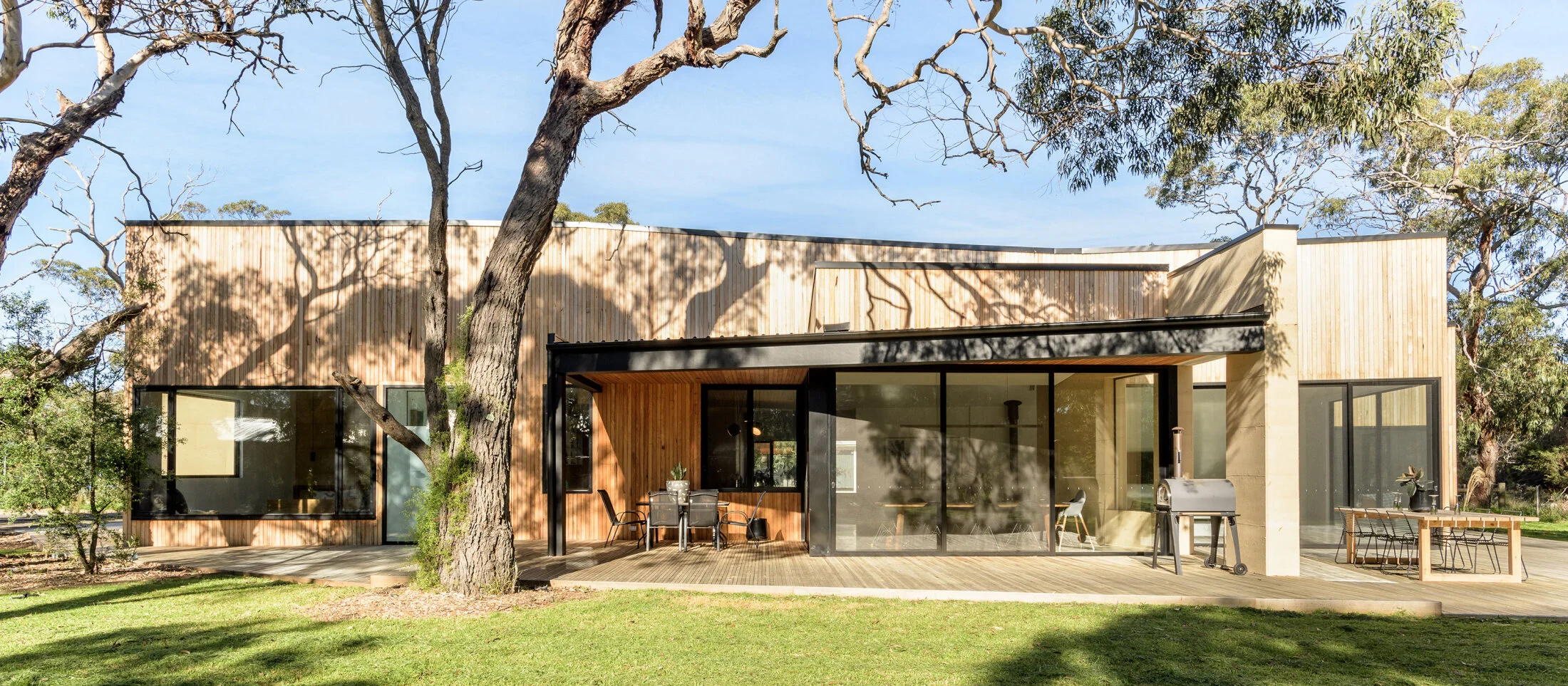
A large, expressive home set beside a native bushland reserve, ‘Yellowgums’ in Ocean Grove is a fine example of a home that achieves exactly that – blending seamlessly into its bushy surrounds.
30th January, 2020
When embarking upon a new build on a vacant block, the surrounding natural environment should always be a priority. For Lorne-based firm Josh Crosbie Architects, fostering a connection to existing wildlife is a core value.
A large, expressive home set beside a native bushland reserve, ‘Yellowgums’ in Ocean Grove is a fine example of a home that achieves exactly that – blending seamlessly into its bushy surrounds.
30th January, 2020


Sally TabartThursday 30th January 2020
‘It was really important to our clients that harmony existed between the house and the surrounding natural environment.’ Josh Crosbie.
Located in Ocean Grove, a Victorian seaside town just over an hour and a half from inner Melbourne, this home was originally designed for a local builder and his young family.
When Josh Crosbie Architects were tasked with this project, the site was flat and vacant, bordering a nature reserve. ‘It was really important to our clients that harmony existed between the house and the surrounding natural environment’, Josh Crosbie tells. Genuine care to make as little impact as possible was a top priority, and the home was designed to ensure that no trees would need to be removed from the site, and even dead trees were left alone, to help protect the native wildlife habitat.
The house itself is impressive and dynamic, both aesthetically and functionally. The client’s ‘passion for irregular shapes’ and desire for a large family home informed a unique design for the dwelling, comprising two triangular forms separated by a large feature curved rammed earth wall. This wall is a defining feature of Yellowgums both inside and out, splicing through the home and drawing apart in the middle to reveal the central kitchen.
Huge glass doors and windows leading from the living spaces out onto the deck make the most of the block’s northern orientation. This, combined with a floor made of a burnished concrete slab, absorbs the winter sun to naturally help regulate the internal temperature. Solar panels, recycled hardwood and a rainwater tank are incorporated into the build.
A simple but strong facade has been achieved through native hardwood cladding of Silvertop ash, which blends elegantly and naturally into the surrounding landscape.
Herald Sun - Laid-back lifestyle by the beach
“It’s was a beautiful house in original condition with a big slate fireplace and really nice views over the water. It was the first and only house we looked at after we decided to move here,” Mr Crosbie said.

When Josh Crosbie and wife Anna initially saw their 1960s beach house on the Great Ocean Rd, it was love at first sight.
“It’s was a beautiful house in original condition with a big slate fireplace and really nice views over the water. It was the first and only house we looked at after we decided to move here,” Mr Crosbie said.
The couple had previously been living in Mr Crosbie’s home town of Geelong, from which the architect and commercial project manager was commuting to Melbourne for work.
“I was burning the candle at both ends and working on projects with budgets of up to half a billion dollars. It was a frenetic, fast lifestyle with an added three hours of commuting every day,” he said.
“I was only seeing my children at weekends and I came to the realisation that I didn’t spend eight years studying (architecture and construction management) at uni to basically have no life at all.”
So, the couple, along with their sons, Levi, now 10, and Jude, now 9, decided on a sea-change. Initially, they moved to the hamlet of Kennett River, but after 18 months, decided to relocate to a larger town for easier access to schools and other amenities.

The made-over home has retained its original charm.

It slots into its bushy environment with ease.

And it has enviable views to the water.
Character driven
Although the beach house was in original condition and needed some work, Mr Crosbie, who heads up Josh Crosbie Architects from offices in Lorne and Geelong, could tell it had good bones.
“The design and layout were beautiful, with an open-plan kitchen in the centre of the home and a sun-drenched sitting room that overlooked the sloping backyard behind us,” he said.
The couple decided on a sympathetic and sustainable renovation that would enhance rather than dramatically change what was already there.
“If a house is gorgeous to begin with, I’m all about preserving the original character and integrity of the home and working with that to show it off,” Mr Crosbie explained.

The sitting room reflects the home’s retro appeal.
One of the first tasks was to replace a “peculiar little deck” at the front of the property with a larger 6m-deep deck with Turkish travertine tiles on the floor.
“It becomes our outdoor living area in the summer and it’s also a good spot to look for whales when they are making their annual migration,” Mr Crosbie said.
Other projects included insulating and re-cladding the house in bushfire-standard native hardwood, replacing windows and doors, re-plastering and painting internal walls and renovating the bathroom and laundry.

The elevated deck is a good whale-watching spot.

It stretches off the open-plan living and dining space.

It has great views and is bathed in sunshine.

And it adds to the home’s indoor/outdoor feel.
Surprise package
The kitchen was overhauled as a surprise for Ms Crosbie while she was on a yoga trip to Bali.
“Literally, within an hour of her leaving for the airport, I had 10 guys in here demolishing the kitchen in a Backyard Blitz-style project,” Mr Crosbie said with a laugh.
He decided to replicate the kitchen’s original layout, even down to the width of the benches, and used handmade Moroccan tiles on the splashback for “a bit of creativity and colour”.
“My friend Adam, who’s an incredible tiler, and I were still tiling that splashback at 3am the night before she returned, and were literally finishing it off as she arrived. But she loved it,” he said.

The kitchen was renovated as a surprise for Ms Crosbie.
Play time
The couple overhauled their sloping backyard by creating two terraces featuring large granite boulders, recycled jarrah sleepers and native plants.

Recycled jarrah sleepers have been used to great effect.
But the most spectacular outdoor improvement is the three interlinked platforms, or tree houses, which were built around eucalypt trees on the property and are used as scenic spots for yoga, sundowners and even sleepovers.
“I’m really proud to say that those tree houses were 100 per cent made with only salvaged second-hand materials and there’s not a single nail or screw that has gone into the trees,” Mr Crosbie said.

High and mighty: the tree houses were built around eucalypt trees.

A tree-house platform gives a bird’s-eye view of the garden.
Mr Crosbie’s thesis was about architecture built within trees and the theme has not only permeated his home, but influenced his architectural practice.
“It’s our No.1 objective to produce design solutions that seamlessly and respectfully assimilate into their environment and produce a beautiful inside/outside connection,” he said.
In a fun touch, the property also has a multi-coloured climbing wall that was built as much for the couple as it was for their sons. (Mr Crosbie’s older son, Kayleb, 20, is also a frequent visitor.)
“I always need to have a little project to work on at home,” Mr Crosbie said. “Seven years after falling in love with this beautiful beach house, we’re still like a pair of pigs in mud, really. We couldn’t be happier.”

The climbing wall is a fun touch.
GT MAGAZINE - A Lorne architects treehouse home celebrates nature
Floating among the coastal stringybarks, the four-bedroom 1960s beach shack has been artfully reimagined to celebrate the natural world.

ARCHITECT Josh Crosbie’s treehouse-inspired home is anchored deep into the steep country above Lorne.
Floating among the coastal stringybarks, the four-bedroom 1960s beach shack has been artfully reimagined to celebrate the natural world.
Together with his wife Annie and two children, Jude and Levi, Josh relishes the location overlooking Louttit Bay, only 100 metres from the water’s edge.

Architect Josh Crosbie wanted to create an environment that was warm, calming and comfortable. Photo: Cricket Saleh
“Although it was in largely original condition, we fell in love with the layout and its potential for improvement,” Josh says.
“We’ve been careful to retain the lovely timber beams and timber internal lining so that the original character and integrity of the house is retained.”
The couple bought the coastal pad more than 10 years ago and gradually added their own touches inspired by a shared love of raw materials.

The children’s Robinson-Crusoe inspired, three-storey treehouse steals the show, complete with thatched roof and amazing water views. Photo: Jane Poynter
Josh says his approach to design is specific to each project but his favourite elements include natural textures like rammed earth, concrete, native hardwood, steel and glass.
“I also love adopting clean strong horizontal lines that sit beautifully within our vast rural landscape, or perched alongside the ocean’s horizon,” he says.
“My main inspiration comes from the raw and powerful elements that are found in the natural wilderness, specifically in the alpine mountains or along the rugged coastline down south.”
Good design elements such as plenty of natural light and sunshine in winter for passive warmth feature in the home.

A mural of bright King Parrots by local artist Loz Green lights up the main entrance. Photo: Jane Poynter
Air flow from natural ventilation, textures and colours, well-proportioned spaces and excellent inside-outside connection to the landscape also help to create an environment that’s warm, calming and comfortable.
“A really dynamic space can be very uplifting and inspirational too,” Josh says.
The sitting room is his favourite place to relax while inside the certified sustainable dwelling.
“The room is beautiful with timber lining and polished hardwood boards,” he says.
“To the rear it steps out onto our backyard which has lovely landscaping with treehouses and terraces made from granite boulders, jarrah sleepers and native plantings.

An original PH5 light fitting from the 1950s has pride of place hanging from the central exposed rafter in the sitting room. Photo: Jane Poynter
“And toward the front it looks through our open kitchen and the living room beyond, and out through the glass sliding doors onto our large front terrace which looks over the ocean.”
He says a strong sight line connects all the most important spaces in the home.
“And to top it off, an original PH5 light fitting from the 1950s has pride of place hanging from the central exposed rafter,” he says.
Outside, the children’s Robinson-Crusoe inspired, three-storey treehouse steals the show, complete with thatched roof and amazing water views.
Further on, terraces are paved with Turkish stone and a mural of bright King Parrots by local artist Loz Green lights up the main entrance.

A stone fireplace provides a striking backdrop to the main living area. Photo: Jane Poynter
Josh studied at Deakin University’s Waterfront campus and completed a double degree of architecture and construction management.
He worked with two Geelong architects while studying and after graduation was a commercial project manager on large-scale jobs in Melbourne for five years.
He started an architectural practise in Geelong which focuses on residential and small-scale commercial projects before moving his office to Lorne about seven years ago.
“We are currently working on our local school and hospital, but most of our work is with houses, both new builds and lots of renovations and extensions,” Josh says.

Jude and Levi play on the outddor rock-climbing wall. Photo: Jane Poynter
“The projects along the Surf Coast are usually quite complex with bushfire risk, land instability, planning controls, steep sites, poor access and dense vegetation.
“We now specialise in this space and enjoy working on difficult projects.”
He says working along the Surf Coast has been a wonderful opportunity to develop projects that respond to their sites and adapt to their landscapes.
“And we love adopting materials and natural textures that suit these natural and sometimes rugged environments such as rammed earth, hardwood timbers, concrete, steel and glass.”
He says his dream project would be to design a house in the high country to host family and friends.

A colourful splashback in the kitchen. Photo: Jane Poynter
“It would serve as a snow chalet during the winter and then a getaway for summer mountain bike and hiking trips away,” he says.
“It would be made with natural elements and have sprawling floor levels that cascade their way down the hillside.”
Looking forward, Josh is keen to share his love of architecture with friends, clients, builders, tradespeople, suppliers and artists in his new Pakington Street office.
“I’ve also started a new co-working space called Pako Collective to share our beautiful office,” Josh says.

A glimpse of the ocean Photo: Jane Poynter
“We’re so excited to launch this collaborative concept and create an amazing creative network hub with like-minded individuals, freelancers, designers and artists.”
You can visit Josh Crosbie Architects at the new office located at 352 Pakington Street, Newtown, or follow @joshcrosbie_architects on Instagram. For more information visit joshcrosbie.com.au
DOMAIN - The architect who built a life-sized treehouse for his whole family
For architect Josh Crosbie, a home should be a reflection of its owners’ personalities. Crosbie applied this same philosophy when it came to dreaming up his own family home

For architect Josh Crosbie, a home should be a reflection of its owners’ personalities. Crosbie applied this same philosophy when it came to dreaming up his own family home, which includes a treehouse designed by Crosbie himself. The architect has had a lifelong fascination with treehouses – the natural kind, not the “American” kind – and spent years researching and writing a thesis on treehouses around the world.
“I’ve rock-climbed pretty much all my life, and mountaineered,” says Crosbie. “I’ve got such an appreciation for big, beautiful trees, and some of the cultures around the world that actually live in trees – like in Papua New Guinea, the Korowai tribe still to this day live up in the tops of these massive trees that are over 50 metres high. I would drop everything in a heartbeat, to be honest, and take the whole family over there and live that simple kind of lifestyle.”

REALESTATE.COM.AU - Josh Crosbie Architects-designed Ocean Grove house, sells to Geelong buyers
A STUNNING house cohesively sitting in a highly desired coastal bush setting has sold to Geelong buyers, despite interstate interest.
The high-calibre Josh Crosbie Architects designed house at 51 Yellow Gum Drive, Ocean Grove sold for $1.563 million.

A STUNNING house cohesively sitting in a highly desired coastal bush setting has sold to Geelong buyers, despite interstate interest.
The high-calibre Josh Crosbie Architects designed house at 51 Yellow Gum Drive, Ocean Grove sold for $1.563 million.
Fletchers, Queenscliff, agent Liam Rock said he was inundated with interest because of the magnitude of the property, where it was located and the build itself.
“The buyer came through the first two opens and were just waiting for the sale of their own house to go unconditional,” Mr Rock said.

GEELONG ADVERTISER - Josh Crosbie Architects design environmentally conscious build
A STUNNING house cohesively sitting in a highly desired coastal bush setting has sold to Geelong buyers, despite interstate interest.
A STUNNING house cohesively sitting in a highly desired coastal bush setting has sold to Geelong buyers, despite interstate interest.
The high-calibre Josh Crosbie Architects designed house at 51 Yellow Gum Drive, Ocean Grove sold for $1.563 million.
Fletchers, Queenscliff, agent Liam Rock said he was inundated with interest because of the magnitude of the property, where it was located and the build itself.
“The buyer came through the first two opens and were just waiting for the sale of their own house to go unconditional,” Mr Rock said.

The house features Astra Walker tapware and custom aged brass rangehood by Qasair.
“We had a lot of interest from Melbourne and interstate looking for a lifestyle change.”
Mr Rock said he received offers from a couple of other groups but the Geelong buyer had the right offer.
“When they saw this they fell in love straight away,” he said.
The architecturally designed house features a curved rammed earth wall, raked ceilings, blackbutt timber cabinetry and polished concrete floors.